
Skip to content

Comparison · 3 min read

Heliyos vs Rox: which one fits your team?

Rox and Heliyos both use the language of a revenue operating system. Rox runs one agent per account over a knowledge graph built on top of your Salesforce or HubSpot, and it is built for the Global 2000. Heliyos is the record and the work in one place, built for growing B2B teams with fewer than twenty sellers.

Rajan Sharma

Rajan SharmaCofounder and CTOUpdated

The short answer

Choose Heliyos if you are a startup or growing B2B team and the follow-ups, prep and proposals on live deals are what slip: it keeps one memory of every customer relationship and its AI workers carry each task through, with or without a CRM underneath. Choose Rox if you run a large sales team on Salesforce or HubSpot and want agents for research, prioritisation and outbound across thousands of accounts.

On this page

Key takeaways

  • Rox is built for the Global 2000 and runs on top of Salesforce or HubSpot, with CRM sync and writeback.
  • Rox starts at $100 a month for one person and $255 a month for a team, billed in agent actions.
  • In Rox the record stays in your CRM, apart from the work. In Heliyos the memory and the work live in one place.
  • Heliyos is built for teams with fewer than twenty sellers, where a few people carry every deal.

The two at a glance

  1. HeliyosRecord + workBest forSmall teams where follow-ups, prep and proposals slipPricingUnlimited seats, priced on work performedRead the entry
  2. RoxEnterprise agentsBest forResearch and prioritisation for large sales teamsPricing$100 to $255 a month, then enterpriseRead the entry

What Rox does well

Rox: revenue agents on your CRM

Best forEnterprise sales teams on Salesforce or HubSpot that want agents across thousands of accounts.

How it describes itself: Revenue Agents for the Global 2000

Pricing
Individual $100 a month (10,000 agent actions), Teams $255 a month (15,000, unlimited seats), Enterprise on request
Sits
On top of Salesforce or HubSpot, with CRM sync and writeback from Teams
Recognition
Named the only Visionary in Gartner’s 2026 Magic Quadrant for Revenue Action Orchestration

The Rox agent researches accounts, monitors them, finds contacts, generates pipeline, writes meeting briefs and manages deals, with multi-channel outbound and enrichment built in. Customers include MongoDB and New Relic.

You pay for agent actions rather than seats, and an activity log shows what the agent did. Enterprise adds data warehouse sync, SSO and a dedicated deployment team.

Strengths
  • Built for scale across thousands of accounts
  • Cheap to start and self-serve
  • Enterprise security and data warehouse sync
Limits
  • The record lives in a CRM you still run
  • Built for the Global 2000 more than a team of five

Rox homepage
Rox homepage, captured 26 October 2026. Visit Rox

Where Heliyos differs

  • The record and the work in one place. Rox works beside Salesforce or HubSpot, so the record and the work stay apart. Heliyos keeps one self-updating memory of every relationship and does the work on it. Use it as your CRM, or keep HubSpot in sync both ways.
  • Built for the team you have. Rox is designed for large sales organisations with RevOps. Heliyos is designed for founders and small teams where a few people carry every deal.
  • Tasks carried to the finish. A Heliyos worker sends the follow-up, waits for the customer and picks up when they reply, then builds the proposal from what was agreed.
  • Outreach at the right moment. Heliyos finds accounts when they become relevant and writes a first message about why now, at the volume a real team sends.

Heliyos: the record and the work, for growing teams

Best forStartups and small teams with live deals, where follow-up, meeting prep and proposals depend on a few people remembering.

How it describes itself: The AI operating system for revenue

Pricing
Unlimited seats, priced on the work performed
CRM
Use Heliyos as your CRM, or keep HubSpot in sync both ways
Approval
Your team approves what goes out, and can relax review one rule at a time
Setup
Connect Gmail or Outlook and a calendar, and the memory builds itself

Heliyos keeps one self-updating memory of every customer relationship, built from email, calls and LinkedIn, plus your playbooks and files. It watches conversations, accounts and the market for moments that matter, from a new account worth pursuing to a deal going quiet, and turns them into tasks.

AI workers complete those tasks on their own computers over hours or days, pausing while they wait for a customer and picking up when the reply arrives. People and workers share the same tasks, so the whole team sees the work and steers it, and every result is written back to the account.

Strengths
  • The work itself: follow-ups sent, meetings booked, proposals ready
  • Work starts when something happens, such as a reply or a deal going quiet
  • One set of tasks shared by people and workers
Limits
  • No Salesforce sync or data warehouse sync
  • Not built for thousands of accounts per rep
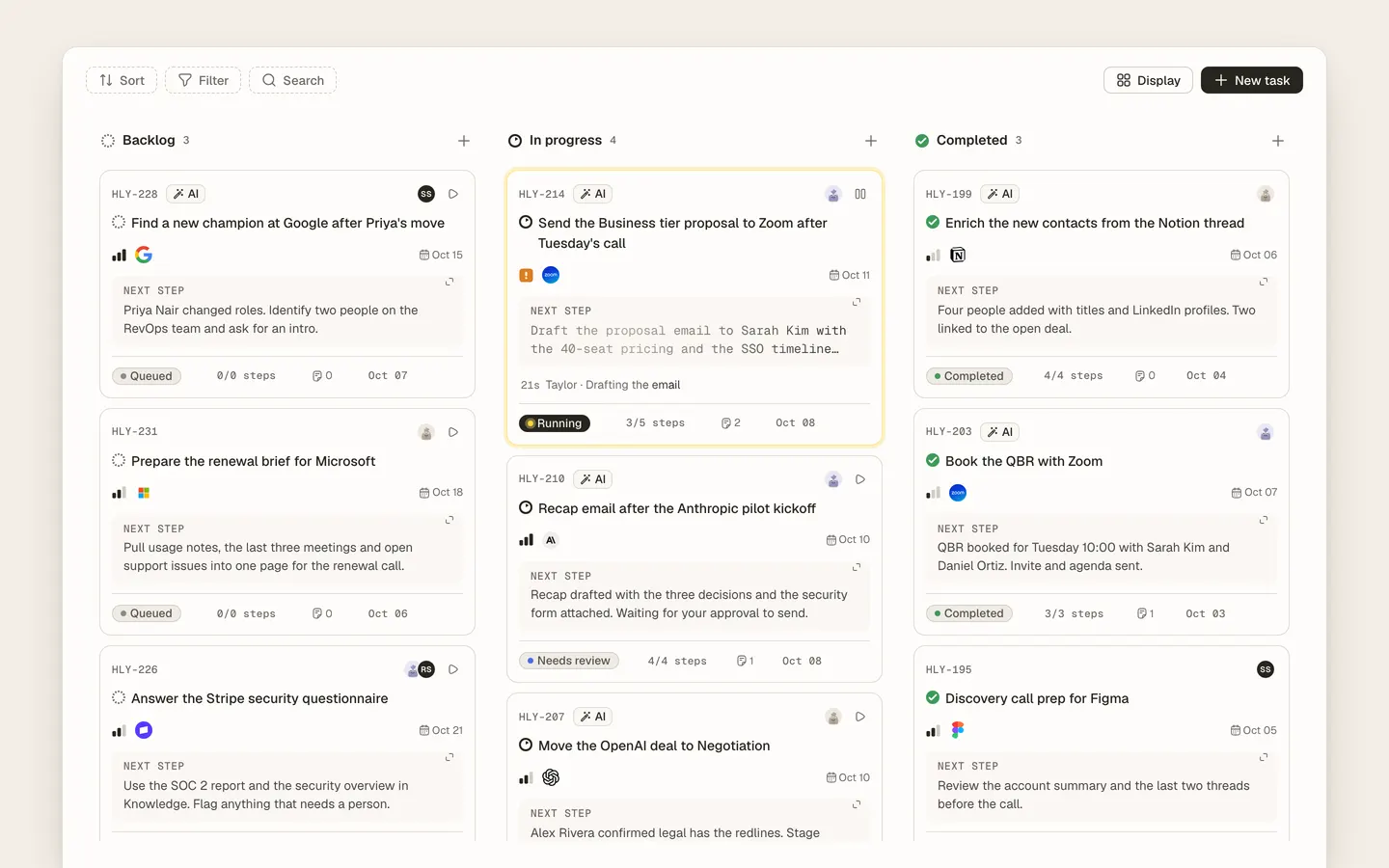
Heliyos task view: people and AI workers on the same tasks
Heliyos: tasks that people and AI workers share, from backlog to done.

How each handles the same deal

One deal, five moments
MomentHeliyosRox
A demo endsThe recap and follow-up are drafted from the call for your approval, and the deal updates itselfThe agent can brief and update the CRM through writeback
The customer goes quiet for a weekA task is created, and a worker sends a nudge built on what they asked aboutThe agent surfaces the account as needing attention
They reply with three questionsThe same task picks back up with the full history and drafts the answersThe reply sits in the inbox and CRM; a rep answers it
They ask for a proposalA worker builds it from the call and your pricing files, and you approve itA rep writes it, with the agent’s research
A teammate takes over the accountEvery conversation, promise and open task is already on the accountThe history is split between the CRM and the agent’s graph
Based on each product’s public pages, checked on 28 October 2026.

Pricing compared

How you pay
HeliyosRox
ModelUnlimited seats, priced on the work performedMonthly plans with agent actions
To startRequest accessFree, then $100 a month for one person
A teamSame plan, unlimited seats$255 a month, unlimited seats, 15,000 actions
A CRM to run as wellNot neededSalesforce or HubSpot, priced separately
Rox prices from rox.com/pricing on 28 October 2026.

Which should you choose?

Rox details and prices checked on 28 October 2026 from its public pages. Tell us if something has changed.

Our take

Rox is a strong choice for large sales organisations that want agents on top of the CRM they already run. If you are a startup or growing team and the work between meetings is what slips, choose Heliyos: the record and the work in one place, with AI workers that carry every follow-up, prep and proposal through.

FAQ

Questions people ask

What is the difference between Heliyos and Rox?
Rox runs revenue agents on top of Salesforce or HubSpot, built for the Global 2000. Heliyos keeps one memory of every customer relationship and does the follow-ups, prep and proposals on it, built for growing B2B teams. You can use Heliyos as your CRM or keep HubSpot in sync both ways.
What is the best Rox alternative for a startup with fewer than 20 reps?
Heliyos, which is built for small teams where a few people carry every deal. Day AI and Lightfield are AI CRMs that keep the record current; Attio fits if you want to design your own data model.
How much does Rox cost?
Rox has a free start, then Individual at $100 a month with 10,000 agent actions and Teams at $255 a month with 15,000 actions and unlimited seats. Enterprise is on request.
Is Rox a CRM?
No. Rox runs on top of Salesforce or HubSpot, with CRM sync and writeback on its Teams plan and above.

Every deal remembered. Every next step done.

Unlimited seats, priced on the work performed. Join the waitlist and we review your request.

We review every request and reply by email.