Guide · Explainers · 4 min read
AI SDR vs AI CRM vs AI operating system for revenue: what’s the difference?
Every vendor in revenue software now says AI, agents and workers. Underneath, they do five different jobs. This guide explains each one, who it fits and where it falls short, so you can tell which one your team actually needs.

Rajan SharmaCofounder and CTOUpdated
The short answer
An AI SDR sends outreach to new prospects. An AI CRM keeps your customer record filled in. An AI operating system for revenue does both jobs, keeping your customer data and doing the revenue work on it, from the first message to the signed proposal.
On this page
Key takeaways
- AI SDRs find conversations. AI CRMs remember them. Few products do both and carry the deal in between.
- AI employees and coding agents are strong general helpers, but they keep no record of each account.
- An AI operating system for revenue keeps your customer data and does the work on it, so every result is saved to the account.
- If an AI SDR spammed your prospects, the fix is timing, history and approval, not more volume.
The five kinds of AI revenue tool
- AI SDRFinds prospects and sends outreach at volume. Hands off after the first reply.
 11x
 Artisan
- AI CRMFills the customer record from email, calendar and calls. People still do most of the work.
 Day AI
 Lightfield
 Clarify
 Attio
- AI employeeOne general agent in Slack with its own computer. Knows what is in the conversation.
 Viktor
 Junior
- AI agent with connectorsThe strongest general agents. Rebuilds each account from your tools on every run.
 Claude Code
 ChatGPT
- AI operating system for revenueHolds every relationship in one memory and does the revenue work on it, alongside the team.
 Heliyos
| AI SDR | AI CRM | AI employee | Agent with connectors | AI OS for revenue | |
|---|---|---|---|---|---|
| Main job | Outreach to new prospects | Keeping the record filled | General help across tools | Whatever task you give it | Keeping customer data and doing the work on it |
| What it knows | Prospect research and the list | Your accounts, from email and meetings | What is in the chat | What it re-reads from tools on each run | Every relationship and how you sell |
| When it acts | On a sending schedule | After each email and meeting | When someone asks | When started or scheduled | When something happens: a reply, a quiet deal, a new account |
| After the first reply | Hands off or starts over elsewhere | Records the reply | Nothing unless asked | Nothing unless asked | Carries the deal forward in the same system |
| Who sees the work | Campaign reports | The record | The person in the chat | The person who ran it | The whole team, task by task |
AI SDR: outreach at volume
An AI SDR finds prospects, writes to them across email and social, handles the first replies and books meetings. 11x runs outbound, inbound and expansion agents across email, social and voice. Artisan describes Ava as an AI BDR that runs outbound end to end.
Fits teams whose constraint is the number of new conversations, with a large market and a message that works at volume. Falls short on timing and history: it has no memory of a customer you have had for two years, and once a prospect replies, the history usually starts over in another tool.
AI CRM: a record that fills itself
An AI CRM builds the customer record from email, calendar and calls, so nobody types it in. The better ones attach a source to every fact and run agents that prepare drafts for you to approve. Day AI, Lightfield, Clarify and Attio lead this group.
Fits teams whose main problem is a stale record and scattered deal history. Falls short on the work itself: agents mostly run inside a chat thread or in the background and hand results back, so people still pick up the follow-up, the prep and the proposal.
AI employee: one agent in Slack
AI employees such as Viktor and Junior are always-on agents that live in Slack with their own computer. You ask, they do. They fit small teams that want a general helper across many kinds of work.
They fall short on accounts: one general agent, with no record of companies, people and deals and no memory of each relationship beyond the conversation.
AI agent with connectors: Claude Code, ChatGPT and Codex
The strongest general agents available. Connect them to your CRM, email, meeting notes and Slack, add scheduled tasks, and they handle a bounded task very well. They fit a technical founder or seller running their own accounts. On a shared pipeline, three gaps show:
- The agent starts from scratch each time and re-reads every tool to rebuild the account.
- It runs when someone starts it or a schedule fires, not when a customer replies.
- It is one person’s setup, which someone maintains, and the rest of the team cannot see the work.
AI operating system for revenue: the record and the work in one place
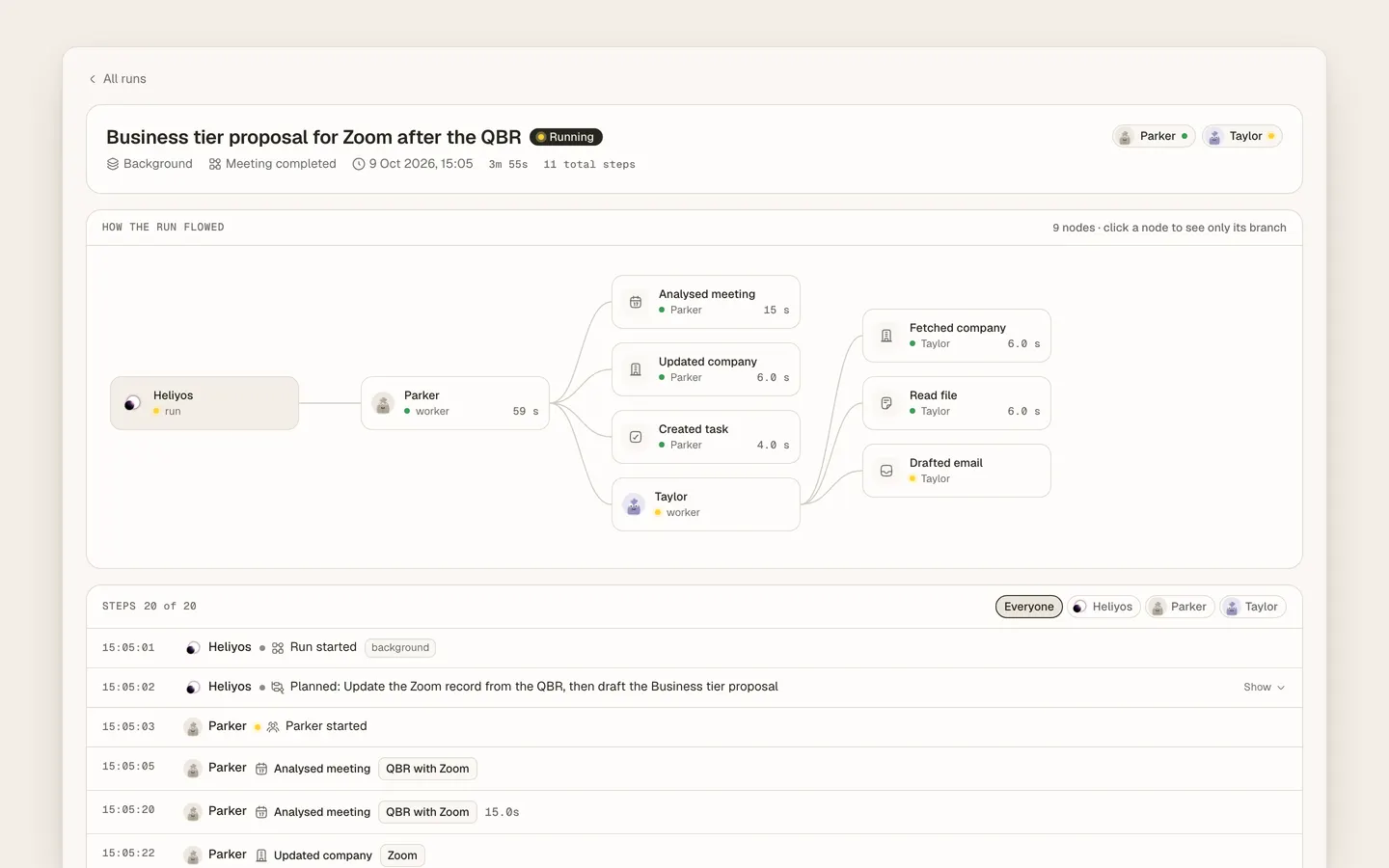
An AI operating system for revenue holds every customer relationship in one memory and does the revenue work on it. It watches conversations, accounts and the market for moments that matter, and turns them into tasks. AI workers complete those tasks alongside the team, and every result is written back to the record. Heliyos is built this way:
- Memory: one self-updating memory of every customer relationship, built from email, calls and LinkedIn, plus your playbooks and files.
- Tasks: a booked call creates the prep, a finished call creates the recap and follow-up, and a deal going quiet creates the nudge.
- Workers: they work on their own computers for hours or days, pause while waiting for a customer, and pick up when the reply arrives. People and workers share the same tasks, and the team approves what goes out.
- New accounts: found when they become relevant, then researched and contacted at the volume a real team sends. The same system carries every deal after the first reply.
Gong and Rox use similar words (“Revenue AI OS”, “Revenue Operating System”) for enterprise products. Their agents work beside a CRM you already run, so the record and the work stay apart.
We tried an AI SDR and it spammed prospects. What now?
This is common. An AI SDR optimises for volume, so on relationship-heavy sales it sends too much, too generically, to people who expected a conversation. Three things fix it:
- 1Act on timing, not a cadenceReach out when an account becomes relevant, such as a raise, a new executive or a launch, with a first message about why now.
- 2Start every message from the historyA follow-up should show it knows the last call, the open question and what was promised.
- 3Approve what goes out until you trust itThen relax approval one rule at a time, not all at once.
An AI CRM handles the second point. An AI operating system for revenue handles all three, and keeps carrying the deal after the reply.
What to check before you hand an AI your accounts
Whatever category you choose, run these checks on your own inbox, not in a demo.
- Approval: which actions wait for a person by default, and is the evidence next to each one?
- Permissions: where does the AI run, and what can it reach? An agent working through a person’s browser session has that person’s access, which is usually too much.
- History: ask it to follow up on an account with a long history. Does the result show it read that history?
- Activity log: can a new teammate open an account and see what was done, by whom and why, in under a minute?
- Pricing: price the full rollout, including credits. Per-seat pricing assumes people do the work.
Our take
Use an AI SDR when the only job is outbound volume, an AI CRM when the problem is a stale record, and a coding agent when one technical person runs a few accounts. When the work between meetings is what slips, look at an AI operating system for revenue, which keeps your customer data and does the work on it. That is what we build at Heliyos.
FAQ
Questions people ask
- What is the difference between an AI SDR and an AI CRM?
- An AI SDR sends outreach to new prospects at volume. An AI CRM keeps the record of your existing customers and deals filled in. One finds conversations; the other remembers them.
- What is an AI operating system for revenue?
- Software that holds every customer relationship in one memory and does the revenue work on it: noticing moments that matter, turning them into tasks, and completing the follow-ups, meetings and proposals alongside your team.
- Is Heliyos an AI SDR?
- No. Heliyos does no volume sending. It finds accounts at the moment they become relevant, reaches out with context at the volume a real team sends, and carries every conversation after the first reply.
- Can I use Claude Code instead?
- For one person and a few accounts, often yes. Once several people share deals, a shared system pays off: one memory, work that starts when something happens, and tasks the whole team can see.
- What is an AI worker platform?
- A term for software that runs AI workers with their own memory, tools and approval step. In revenue, the same idea now sits inside AI operating systems for revenue, where the workers act on one shared record of every customer.
- Do these tools replace sales reps?
- They take routine work: record updates, follow-ups, prep and research. People keep the relationships and decisions, and approve what reaches a customer.
Every deal remembered. Every next step done.
Unlimited seats, priced on the work performed. Join the waitlist and we review your request.