Workers · Unified memory
Unified memory: one truth per account, and a computer to work on it
Every worker in Heliyos reads and writes the same memory for an account: the company, its people, the deal, every email, meeting, note and signal. Each worker runs on its own computer with your tools and files. Nothing is copied, nothing goes stale, and every change shows where it came from.
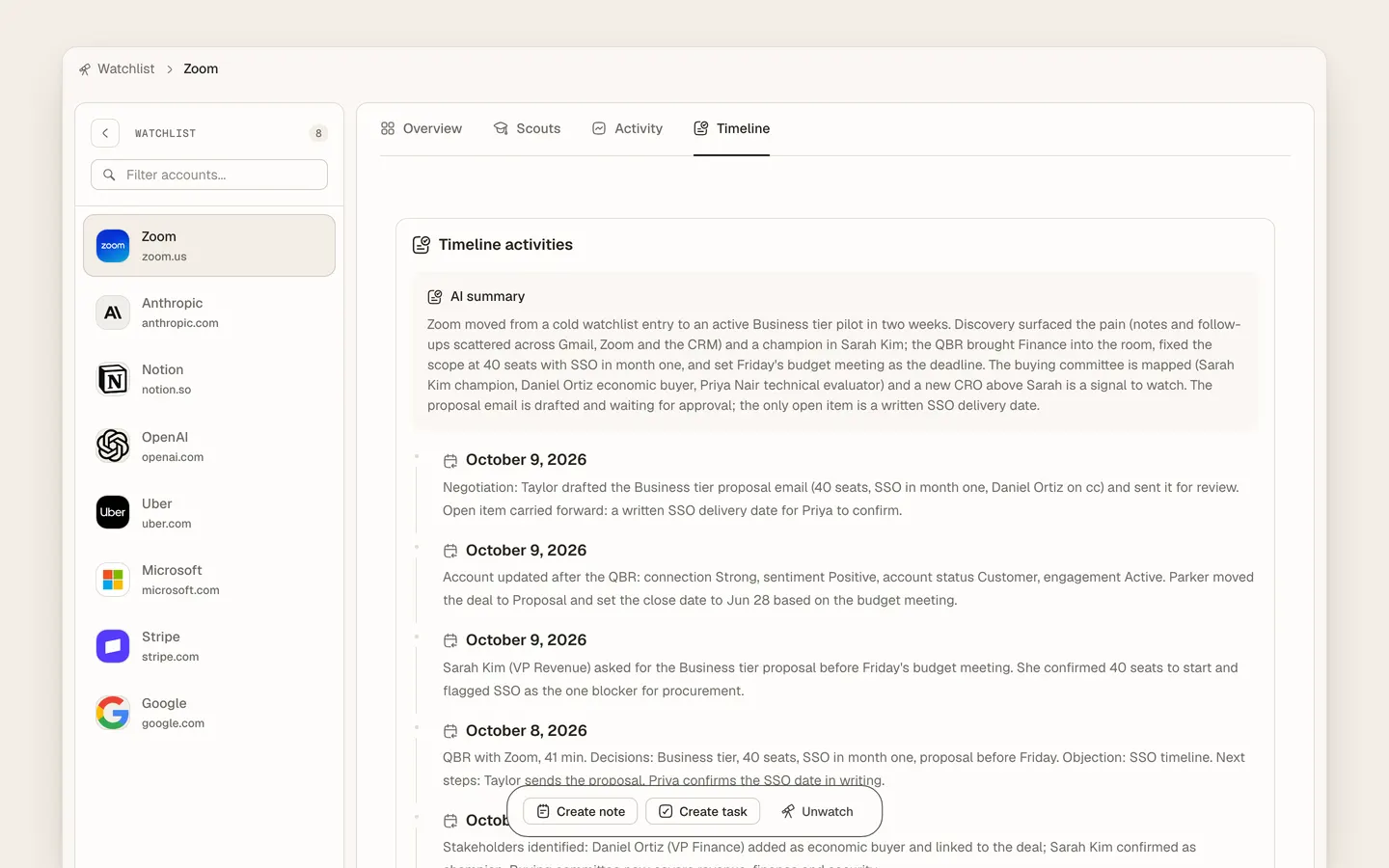
Unified memory is how Heliyos keeps AI workers from acting on the wrong facts. Each account has one memory: summary, people and roles, deal state, the full timeline of emails, meetings, notes and signals, plus your knowledge base. Taylor, Parker and custom workers all read that memory before a run and write their results back to it, so the next worker sees what the last one did. A worker runs in its own sandboxed computer with the tools its job allows, which means it can read a transcript, search the web, write a document and update the record in one run, with every step logged.
Use cases
Use cases
A rep leaves and nothing leaves with them
The account memory holds every conversation, meeting and decision. The next owner, or the next worker, picks up with the full history, not a notebook.
Two workers never contradict each other
Parker updates the deal after a call; when Taylor drafts the follow-up ten minutes later it reads the updated deal, not a copy from this morning.
Context from six tools, one record
Gmail, calendar, LinkedIn, meeting transcripts, Typeform responses and Drive files land on the account they belong to, linked to the person and the deal.
Workers use your real files
Pricing sheets, decks and docs from Google Drive or OneDrive are read as knowledge. A proposal Taylor writes uses your current pricing, not a guess.
A computer with a scope
Each run executes in a sandbox with only the tools the job lists. Taylor can send email; Parker cannot. Neither can touch another company’s records.
Every fact has a source
A field, a stage or a summary line links to the email or transcript passage it came from, so a person can check any decision in seconds.
How it works
How it works
- 01
Everything lands on the account
Connected inboxes, calendars, meetings, forms and files attach to companies and people automatically.
- 02
A worker reads before it acts
A run starts with the account memory, the trigger and the knowledge base. No prompt contains stale data.
- 03
It works in its own computer
The run has a sandbox with the allowed tools: search, documents, email, calendar, records. Every call is logged.
- 04
It writes back with evidence
Results, changed fields and created tasks go onto the memory with source links, visible to the team and the next worker.
Workers
Who works here
Workers show up where the team already is, with a clear marker for who did what. Your own custom workers join them.
 Taylor
 Parker
FAQ
Questions people ask
- Why do AI agents get CRM data wrong, and how does Heliyos avoid it?
- Most agents work from a copy of the data pasted into a prompt, which goes stale and has no source. Heliyos workers read the live account memory at the start of each run and link every change to its evidence, so stale or invented facts are caught before they spread.
- Do workers share memory with each other?
- Yes. All workers read and write the same memory per account, so Parker’s update is what Taylor sees next, and a custom worker sees both.
- What is the "computer" a worker uses?
- A sandboxed runtime per run with the tools the worker’s job allows: web search, document creation, email and calendar through your connected accounts, and record updates. Nothing runs outside that scope.
- Can workers read my Google Drive or OneDrive?
- Only the folders you connect. Those files become knowledge the workers cite when they write proposals, briefs and replies.
Deploy your first AI worker, today.
Closed beta, usage-based pricing, no seats. Join the waitlist and we review your request.